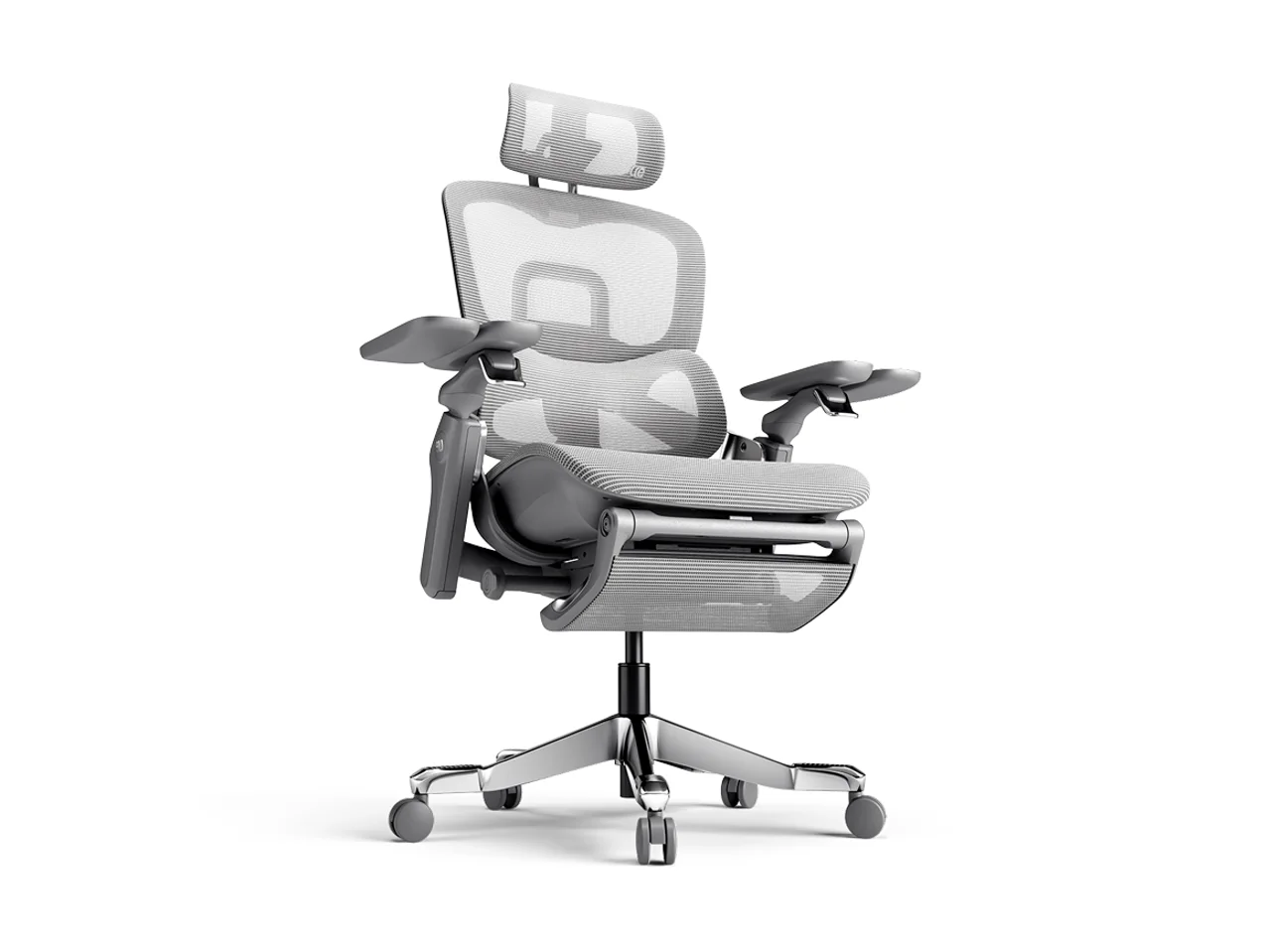
Every mesh chair looks taut in the showroom. The question that decides a wholesale program is whether it is still taut after eighteen months of daily use — and that comes down to two things a price quote usually hides: the mesh material and how it is held at the edge. On our ergonomic office chairs we spec both, so let me explain what we are choosing between and why.
Elastomer vs polyester knit
Broadly there are two families. Polyester (or nylon) knit mesh is the common, affordable option — light, breathable, fine when it is woven well and tensioned properly. Elastomeric mesh, including TPEE-type elastomer, is the higher-performance material: it balances softness and stretch with real strength, heat resistance and fatigue durability, which is the property that matters for a seat that gets sat in thousands of times. As the material guides put it plainly, elastomer holds its tension; a budget polyester knit loses it.
The failure you can predict from the material is sag. A cheap polyester mesh stretched thin can start to dip within a year of daily use — the user feels the front edge of the frame through the seat, and your reseller gets the email. A good elastomer back or seat resists that for years. The catch for a buyer is that you cannot tell the two apart by sitting on a fresh sample; both feel taut on day one. You tell them apart from the spec and a pull test, which is why we name the mesh type and weave rather than writing "high-quality mesh" and leaving it vague enough to swap later.
The part nobody photographs: the edge
Mesh rarely tears in the middle. It fails at the binding — where the mesh meets the frame. A thin frame with a cheap edge channel lets the mesh creep and pucker at the corners, and that puckering is what looks worn long before the surface does. There are a few ways to hold mesh: a sewn-and-stretched panel, an injected/over-moulded edge, or a tension-rod frame. The over-moulded and rod methods hold tension more evenly over time; the cheapest sewn panels rely on the fabric alone and relax at the corners. So when we evaluate a mesh chair we look as hard at the frame edge and the tensioning method as at the mesh itself. A premium mesh stretched on a weak frame is a false economy.
Breathability and the heat question
Mesh sells on breathability, and that is genuinely the right call for hot, humid markets where a padded seat traps heat against the body. But "mesh" is not one thing here either: a dense, fine knit breathes less than an open weave, and a thick elastomer can sit warmer than a light polyester. If your market is the Gulf or Southeast Asia, an open, breathable weave is worth specifying explicitly — do not assume any mesh solves the heat complaint. If your market is colder and your buyers expect a softer feel, a foam seat with a mesh back is often the better split.
The trade-off we put on the table
Here is the call. For a sharp-priced home-office or task line, a good polyester knit is honest value — breathable, light to ship, and fine for a few hours a day. For a contract chair going into an open-plan office where it gets eight hours of mixed use, we push you to an elastomer back, and yes, it costs more per unit. The reason is not feel on day one; it is the sag you avoid in year two and the warranty claims you do not field. We have watched buyers switch to the cheaper knit on price and reorder the elastomer after the returns came in.
One configuration that often wins: elastomer where the body loads heaviest and a breathable knit where it does not, tuned to the price point. It is not a fence-sit; it is the build that generates the fewest complaints for the money. The same logic of supporting the body where it actually loads runs through our lumbar support note.
A practical test for any sample, by the way: sit, lean, and run a hand along the front edge of the seat, then leave a heavy colleague on it for ten minutes and check the edge again. Cheap mesh telegraphs the frame edge under load almost immediately; good mesh and a proper edge channel do not. It costs you ten minutes and tells you more than the brochure. The mesh also feeds the warranty math — a seat that sags is a return — which is why we treat it alongside the spare-parts and warranty conversation rather than as a cosmetic choice.
Tell us your target retail price and market and we will recommend a mesh type, weave and edge method, and quote it in writing. We build to BIFMA / EN test methods and testing can be arranged. Reach us on the contact form or read our ODM / OEM page.