"We want good lumbar support" turns up in almost every enquiry that crosses our desk. It is also the line with the least number behind it. So before we quote a chair, we try to turn that sentence into something measurable, because the ergonomics research is fairly specific about what lumbar support is doing to the spine — and a buyer who knows the numbers writes a better spec.
What the spine is actually doing when you sit
Your lower back has a natural inward curve — lumbar lordosis. When you sit upright without support, that curve flattens, and the load on the lumbar discs goes up. Makhsous and colleagues measured this in 2009: compared with standing, unsupported sitting reduces lordosis and raises both disc pressure and lower-back muscle activity. A lumbar support is not a comfort gimmick. Its job is to push the lower back toward the curve it holds when you stand, so the deep muscles do not have to fight to hold you there.
The classic in-vivo disc-pressure work, going back to Nachemson and later refined by Wilke, makes the payoff concrete. Sitting upright loads the lumbar discs more than relaxed standing. But sitting and leaning back into a chair that actually supports the lumbar region drops L4–L5 pressure markedly — relaxed reclining brings it down toward the region of 0.27 MPa, far below tense upright sitting. The lesson for a chair is blunt: the recline and the lumbar support have to work together, or you are selling a backrest the user fights instead of leans into.
The number most buyers never ask for
Depth. A 2016 modelling study by Guo and colleagues looked at how far a lumbar support should protrude and found that a support depth around 10 mm was close to optimal for comfort and for lowering disc stress. Push it too far forward and you create a pressure point the user dials out within a week; too little and it does nothing. This is why a fixed, moulded lump of foam stamped "ergonomic" is mostly marketing — the depth is whatever the mould happened to give, not a figure anyone chose.
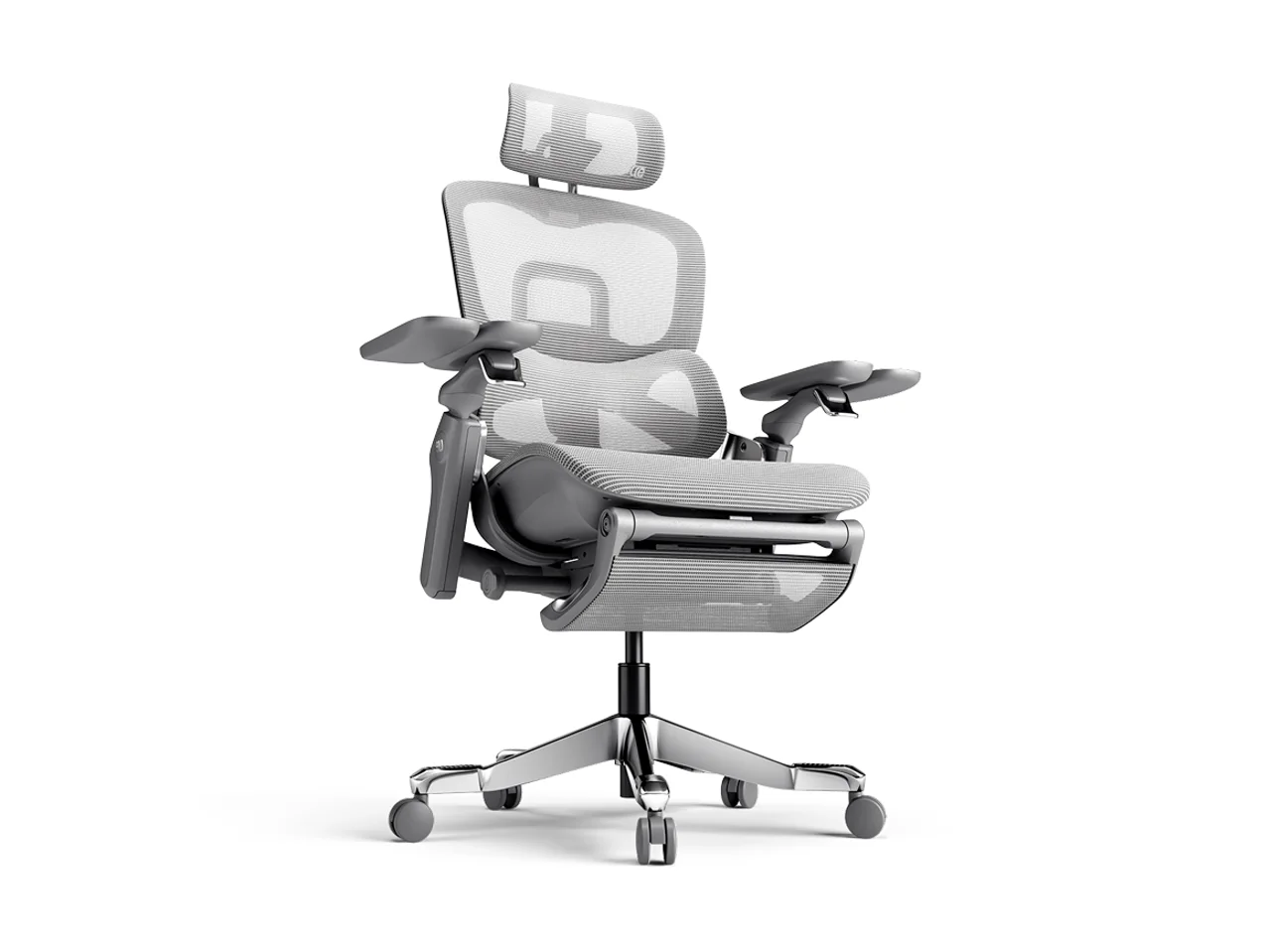
Height is the second number. A support set at the wrong height pushes on the wrong vertebrae, and a tall user and a short user do not share a sweet spot. That is the case for an adjustable, following lumbar mechanism rather than a static pad. On our ergonomic office chairs the lumbar height adjusts and the support tracks the back through recline, so the effective ~10 mm of support stays where the spine needs it across a range of body sizes — not just for the person the prototype was fitted to.
Following lumbar vs fixed pad — what actually changes
A fixed pad supports you in one posture: the upright one. The moment you recline to read or take a call, the pad and your back part company, and the support disappears exactly when the disc-pressure research says it helps most. A following system keeps contact through the recline arc. There is also the question of force — too stiff a support and people perch forward off it; too soft and it collapses. We tune the spring or tension so the support yields slightly under load and pushes back, rather than acting like a fixed bump.
The trade-off we put on the table
Here is where I will argue against the spec sheet. A four-way adjustable, dynamically following lumbar system is genuinely better ergonomics, and it costs more — a real mechanism, more parts, more assembly time. For an executive or a knowledge worker sitting eight hours, it pays for itself in fewer complaints and a chair people keep. For a meeting-room or guest chair used twenty minutes at a time, it is money spent on a feature nobody will adjust. We have shipped both, and we would rather steer your budget toward the adjustable support on the chairs that get sat in all day and a correctly-positioned fixed support on the occasional-use line.
One honest caveat on the claims. No backrest "corrects your posture" on its own — the research shows support reduces load, it does not immobilise a slouching user, and it does not cure an existing back problem. We will not print that it does. What we build to is the part the evidence supports: a support that encourages the lumbar curve, at a sane depth, at an adjustable height, that stays in contact through recline.
If you are speccing a chair program, tell us the daily sitting hours and the user profile and we will recommend a lumbar system — adjustable or fixed — with the depth and height range written into the spec rather than left to "ergonomic." See how we adapt a platform on our ODM / OEM page, or send the brief through our contact form. We build to BIFMA / EN test methods and third-party testing can be arranged. Related reading: our note on mesh tension and sag, which decides how that support feels in year two.