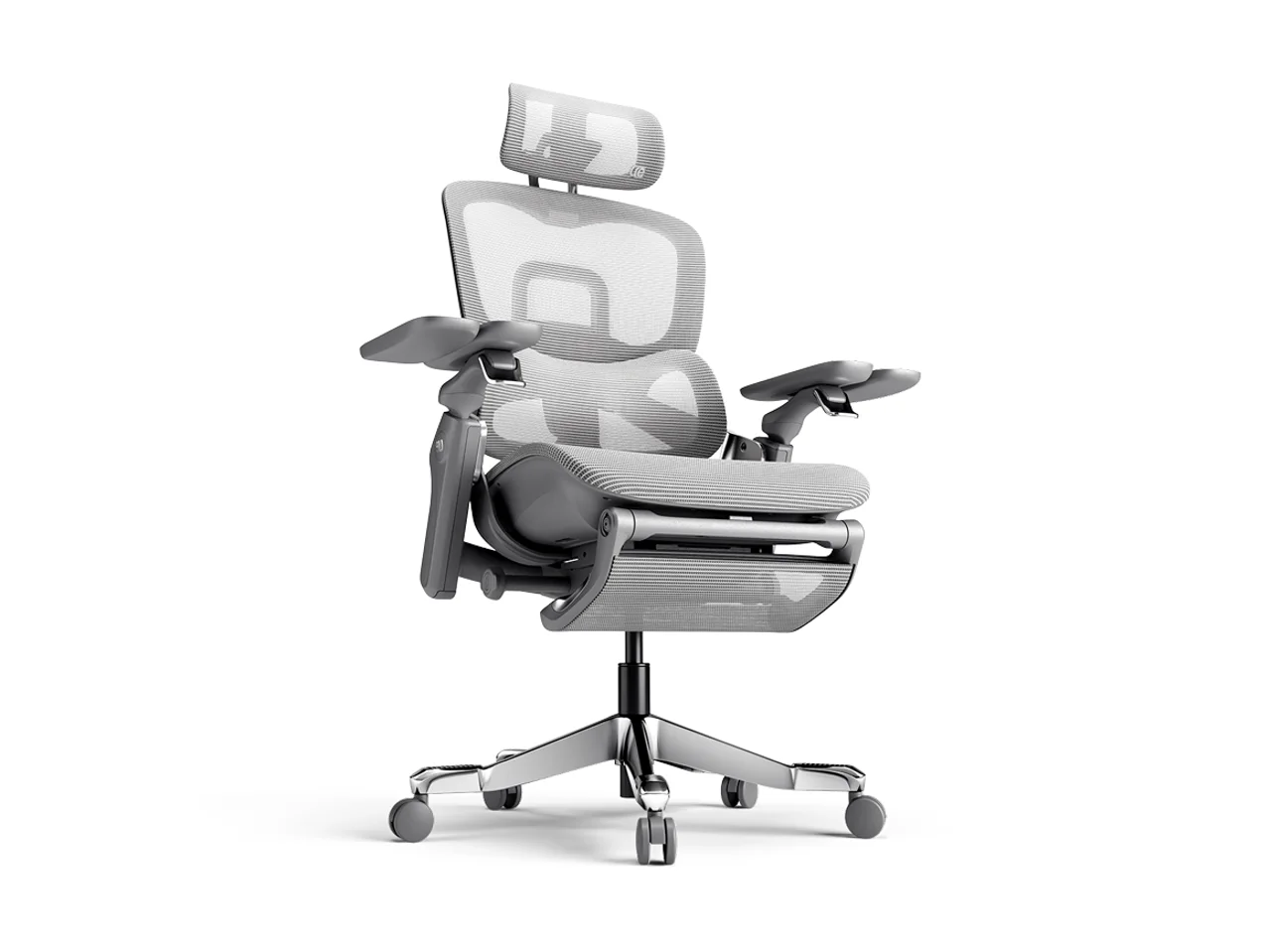
Armrests are where the spec sheet gets loud. "4D adjustable!" — as if more axes were automatically better. The useful question for a buyer is narrower: which of those adjustments does a real user actually touch, and which just add cost, parts and a future rattle? Here is how we think about it on our ergonomic chairs, and how to spec arms without paying for motion nobody uses.
What the "D"s mean
The convention is roughly this. A 2D armrest adjusts in two axes — usually height and width (sliding in and out). A 3D armrest adds a third, commonly depth (sliding forward and back) or a pivot. A 4D armrest does all four: height, width, depth and a pivot or angle. The marketing implies a ladder where 4D is "best," but the axes are not equally useful, and treating them as a single number hides which one your user actually needs.
Which axis matters most
Height is the one that matters most. The ergonomics setup guidance is consistent: the armrest should support the forearm with the shoulders relaxed and the elbow near 90 degrees. An armrest set too high pushes the shoulders up and loads the neck; too low and the user leans to one side, loading the back. Get height wrong and the other three axes are decoration. Width matters next — a wide fixed armrest that does not pull in leaves a small user perched away from the backrest, losing the lumbar support entirely. Depth and pivot are genuinely nice for keyboard-and-mouse work, letting the forearm stay supported as the hands move forward, but they are the axes most users set once and forget. So the honest ranking is height, then width, then depth and pivot — not "more is better."
The headrest question
Headrests follow the same logic. On a chair that reclines — an executive seat, or a task chair people lean back in to read or take calls — an adjustable headrest supports the neck through the recline and is worth the money, because the neck angle changes as you recline and a fixed headrest only fits one position. On an upright task chair that nobody reclines in, a headrest is mostly visual; a fixed one adds cost and a part that can loosen, for a benefit the user rarely feels. We have shipped both, and we will tell you when a headrest is selling a picture rather than a function — a tall headrest photographs well and does nothing for a chair locked upright.
The part that quietly fails
Every adjustment is a mechanism, and every mechanism can develop play. The most common field complaint on adjustable arms is not breakage — it is a wobble or a click that appears after a year, when a worn lock or a thin pad bushing starts to move. The chair is structurally fine, but the user perceives it as cheap, and that perception drives reviews and returns. So two things matter beyond the axis count: the quality of the lock that holds each position, and whether the arm is a replaceable module when it does loosen. That ties straight into warranty and spare parts — a 4D arm that fails should be a swap, not a reason to scrap the chair.
Armrest pads and the surface nobody specs
One detail that drives more day-to-day complaints than the axis count: the armrest top pad. A hard, thin PU pad gets shiny, cracks at the edges and feels cheap within a year of forearm contact; a softer, thicker PU or a moulded TPU pad wears far better and is the part users actually touch all day. It is also a low-cost upgrade and an easy replaceable spare. So when we spec arms we treat the pad as a real choice, not an afterthought — because a 4D arm with a cracked pad reads as a failed chair to the end user even though every mechanism still works. If your market is hot, a pad that does not get tacky in heat is worth asking for by name.
The trade-off we put on the table
More adjustment is not free. Every extra axis is a mechanism: more tooling, more assembly, more cost, and one more thing that can rattle after a year. For a flagship executive or a heavy-duty task chair, 4D arms and an adjustable headrest are the right build and they justify themselves in fewer ergonomic complaints. For a value line, a solid 2D height-and-width arm with a clean, firm lock is honest engineering; pretending a budget chair needs 4D just adds wobble and cost the buyer will not thank you for. We would rather put the budget into the height adjustment locking cleanly than into four axes that loosen.
Tell us the user profile and price point and we will recommend an armrest grade and whether a headrest earns its place — and spec it so the adjustments lock cleanly and the arm is serviceable. Reach us on the contact form or see the range on our products page. Built to BIFMA / EN methods; testing can be arranged.