블로그

One chair, many bodies: percentile sizing for buyers selling into more than one market

A distributor who sells the same chair in Rotterdam and Kuala Lumpur is, whether they know it or not, asking one seat to fit two quite different populations. Most of the time nobody states this on the spec; the chair is simply "ergonomic," and the misfits surface a year later as vague complaints — feet dangling, knees hitting the seat edge, armrests that will not go low enough. The engineering behind getting this right is not exotic. It is percentile arithmetic, and a buyer who can follow it writes a far better multi-market spec.

What "5th to 95th percentile" actually commits you to

Ergonomic sizing aims to fit everyone from the 5th-percentile female to the 95th-percentile male of the target population — by convention, the middle ninety percent of bodies. The two ends are startlingly far apart. Seated popliteal height — floor to the back of the knee, the number that sets usable seat height — runs from roughly 355-380 mm at the small end to 490-500 mm at the tall end across global populations. No fixed seat height fits both; that is why adjustment ranges exist, and why the range, not the mid-point, is the spec that matters.

The catch for a global buyer: those percentiles are population-specific. The 5th-percentile female in Northern Europe is taller than the 5th-percentile female in Southeast Asia; the 95th-percentile Dutch male is among the tallest on earth. Average stature between the tallest and shorter-stature markets differs by roughly eight to ten centimetres, and the seated dimensions shift with it. A range that comfortably brackets one market can clip the bottom or top of another.

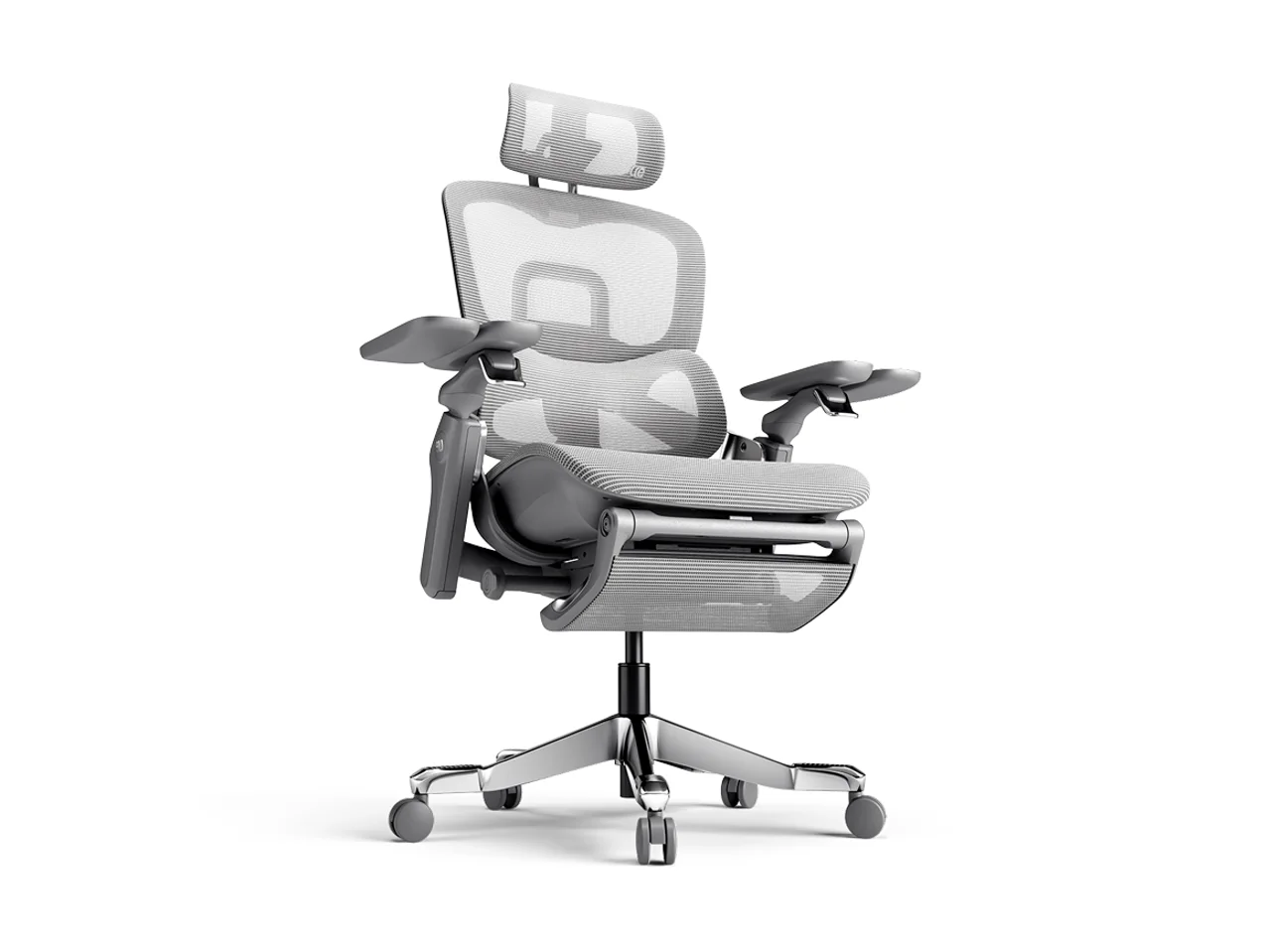
UE Furniture ergonomic mesh office chair with adjustable headrest and lumbar — the platform that gets re-ranged per market
Same platform, different cylinder stroke and depth range per destination market — the cheapest form of localisation we know.

The three dimensions that do the work

Seat height. EN 1335 Type A asks for an adjustment range on the order of 400-510 mm, which brackets European populations well. Ship that identical chair to a market with shorter average stature and the bottom of the range is the problem: a user whose popliteal height is 370 mm sits on a 400 mm seat with heels just off the floor, pressure under the thighs, and no idea why the chair tires them. The fix costs almost nothing — a shorter-stroke gas cylinder drops the whole range by 20-30 mm. Same chair, same tooling, different cylinder on the BOM line.

Seat depth. The governing number is buttock-popliteal length, about 440 mm at the 5th-percentile female. The working rule is a clearance of 30-50 mm between seat edge and the back of the knee, so a fixed 470 mm-deep seat — common on chairs styled generous for North American retail — is simply too deep for a large share of users in shorter-stature markets: they either lose lumbar contact by perching forward or take pressure behind the knee. A seat-depth slider covering roughly 380-420 mm of effective depth resolves it across markets; on a fixed-depth budget line, the honest move is to spec the shallower pan for the shorter-stature market rather than ship the deep one everywhere.

Armrest height range. Seated elbow height spans roughly 180-300 mm above the seat across the band. A range that stops short at the bottom punishes smaller users, who end up shrugging onto armrests that will not drop — and it interacts with the desk: in markets where 720-740 mm fixed-height desks are still the norm, smaller users raise the chair to reach the desk and then need a footrest, which your spec should anticipate rather than discover. Which adjustments users actually exploit is a separate argument we made in our note on headrests and 4D armrests.

One platform, regional trims — not regional chairs

The wrong conclusion from all this is "design a chair per market." That multiplies tooling, certification and inventory for no good reason. The right conclusion is one platform with market trims, because the three dimensions above are all controlled by swappable parts: the cylinder sets the height band, the slider or pan sets depth, the armrest column sets the elbow range. On our ergonomic chair platforms that is exactly how a multi-market program runs — one shell, one mechanism, one mesh, with a per-market BOM page that changes three line items. Inventory stays sane because the variant parts are small and cheap to hold, and the engineering work done on the platform carries across trims.

The trade-off we put on the table: a trim program only pays above a certain volume per market. Below a container or two a year per destination, hold the wide-range configuration — full-stroke cylinder, depth slider, long armrest range — and accept a slightly higher unit cost for the flexibility. Adjustability is the insurance policy; trims are the optimisation once volume justifies them.

Verifying fit before you commit

Two checks separate a real percentile spec from a brochure claim. First, ask the factory to state which population data the ranges were set against — a chair sized to North American BIFMA G1 guidance and one sized to East Asian survey data are legitimately different, and "ergonomic" covers both. Second, run a fit trial: five minutes each with your shortest and tallest available staff, checking feet-flat at lowest seat height, two-finger clearance behind the knee, and armrests reaching both elbow heights. It is crude, but it catches the misfits a spec sheet hides. On the formal side, our chairs are built and tested to EN 1335 and BIFMA X5.1 methods, with dimensional verification included in third-party testing that can be arranged per order — the dimensions are measured in those protocols, not just the strength.

If you are quoting a chair into more than one market, send us the destination list and we will come back with the range each one needs and the trim parts that get you there — through the contact form, or start with how a platform program works on our ODM / OEM page.